


 Breaking News
 Shalini
 Shalini
 May 07 2026
 749
749The Federation of Renewable Energy Developers (FRED), the apex body of renewable energy developers in Sri Lanka and an associate of the Ceylon Chamber of Commerce, warns that unless the Government steps in to resolve the financial crisis the industry is in due to the payment defaults by the National System Operator (Pvt) Limited (NSO), the domestic renewable energy sector faces a natural death.
Payments for renewable energy supplied to the national grid have been entirely halted since December 2025. With LKR 2.5 Billion falling due each month, the defaults have ballooned to an unsustainable LKR 10 Billion as of April 2026.
The Root Cause: Prioritizing Expensive Fossil Fuels Over Sustainable Energy
According to senior officials at the NSO, the primary reason for this liquidity drain is the prioritization of payments for diesel and heavy fuel power generation to operate approximately 100MW to 150MW of daily supply shortfall arising from inefficiencies and shortfalls in coal power generation since December.
Driven by the ongoing geopolitical conflict between Iran and the US, the cost of generating this thermal power has skyrocketed to exorbitant levels, nearing or exceeding LKR 100 per kWh.
It is fundamentally unfair that conventional power generators receive preferential treatment for disbursements while the renewable energy sector is completely forgotten. FRED demands that the exact same payment priority afforded to coal, diesel, and heavy fuel operators must be extended to renewable energy developers. FRED warns that prioritizing payments for expensive fossil fuel powerplants, and defaulting on the renewable energy developers who provide significantly cheaper and cleaner energy, can have a backlash if those operators are forced out of business leaving a bigger supply shortfall.
Affected Capacity
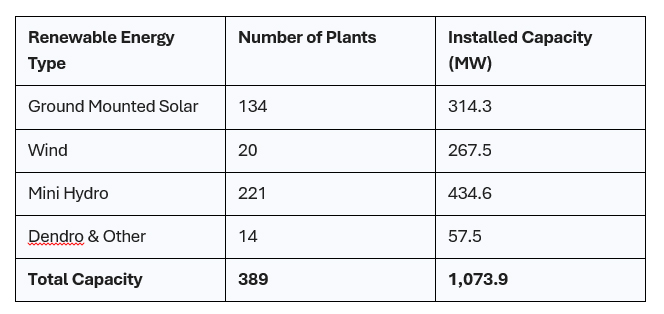
This crisis directly impacts ground-mounted, mini-hydro, wind, and biomass installations across the country, excluding rooftop solar. The affected capacity currently bearing the brunt of this non-payment includes:
Severe Industry Fallout
This unfair and disproportionate treatment is devastating close to 400 small and medium-scale companies (SMEs) and local entrepreneurs. The downstream effects are catastrophic:
- Looming Financial Defaults: Power plant owners are increasingly unable to service their bank loans. This threatens to create a massive wave of Non-Performing Loans (NPLs) within the banking sector, risking broader economic instability.
- Massive Threat to Livelihoods: Company owners have exhausted their personal funds. If the NSO does not release payments immediately, thousands of employees—including technical staff, laborers, electricians, mechanics, engineers, and administrative staff—will go without salaries.
- Operational Stagnation: Without revenue, operators cannot purchase essential spare parts required for routine maintenance. This will inevitably lead to plant breakdowns, reducing the availability of renewable power and further exacerbating the national energy deficit.
- Destruction of Investor Confidence: The blatant disregard for payment agreements is severely damaging investor confidence. Future renewable energy tenders are likely to see drastically reduced participation and much higher quoted tariffs due to the elevated risk profile of doing business with the state.
- Risk to Sovereign Credibility & Climate Goals: This situation jeopardizes Sri Lanka's credibility with international funding agencies. Furthermore, stifling the renewable energy sector actively derails the nation’s long-term clean energy targets and sustainable development goals.
Urgent Call to Action
To avert the complete collapse of the renewable energy sector and prevent reciprocal damage to the broader economy, FRED urgently requests the Government of Sri Lanka to take the following immediate actions:
- Immediate Treasury Intervention & Grant Allocation: If the NSO is unable to secure commercial funding due to its status as a new corporate entity lacking substantial collateral, we strongly urge the Ministry of Finance and the General Treasury to intervene. Furthermore, if the Government of Sri Lanka or the Treasury issues a grant, LKR 10 Billion out of it must be strictly allocated for the payments of RE developers.
- Cabinet Intervention: Issue an immediate Cabinet directive to authorize and expedite these financial solutions before the SME energy sector is forced into mass default with domestic banks.
The Federation of Renewable Energy Developers stands ready to work with the government to ensure a stable, sustainable, and economically viable energy future for Sri Lanka, but immediate financial relief is non-negotiable to keep the lights on today.
Source: Adaderana