


 Breaking News
 Puvanya
 Puvanya
 Oct 14 2026
 34
34- Emerging and developing Asia to average at 2.7% in 2026
- Inflation projected at 5.3%, reversing 2025 deflation
- Local growth expected to slow to 4% this year
Sri Lanka’s inflation is set to run at nearly double the emerging Asian average this year and to keep edging higher into 2027, the International Monetary Fund (IMF) projected on Tuesday (13), placing the country in line with a profile the fund describes as facing “the most difficult configuration” in a bifurcated global economy: an energy importer with little connection to the technology value chain that is lifting much of East and Southeast Asia.
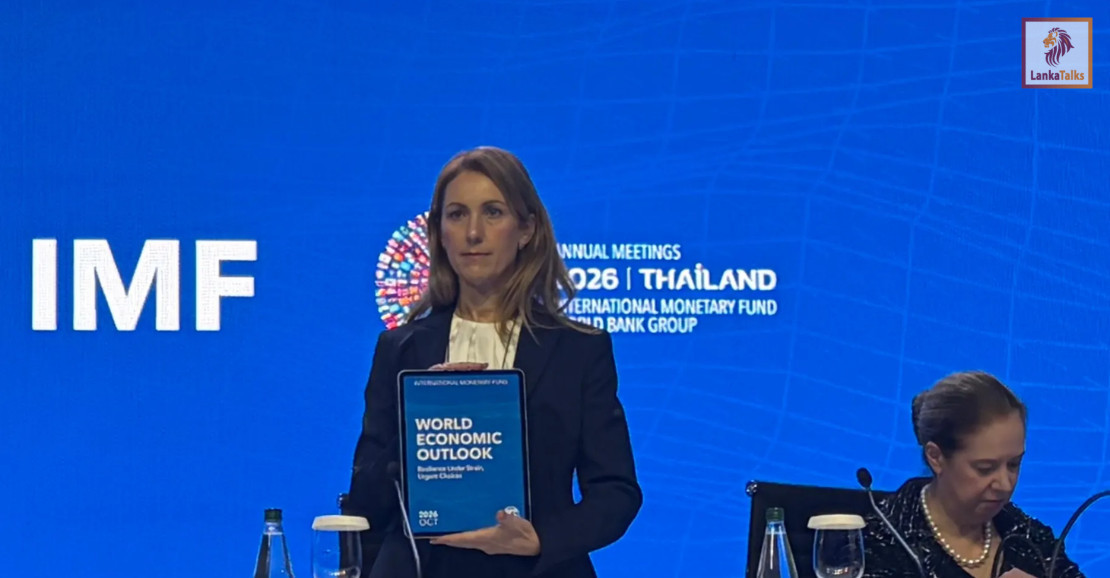
According to the IMF’s October 2026 World Economic Outlook (WEO), released at the IMF-World Bank Group Annual Meetings in Bangkok, Sri Lankan consumer prices are projected to rise by 5.3% this year and 5.4% next year. That is a sharp reversal from 2025, when prices fell by 0.5%. The projections would keep inflation marginally above the Central Bank of Sri Lanka’s (CBSL) 5% target in both years.
Sri Lanka’s inflation is set to far outpace the region’s. The IMF projects inflation in emerging and developing Asia to average 2.7% in both 2026 and 2027, which means Sri Lanka’s rate this year would be nearly double the regional average. Next year, inflation is expected to ease in India, Indonesia, Malaysia, Thailand and the Philippines, while Sri Lanka’s edges are higher.
The country’s external buffer is also expected to thin. The IMF projects the current account to swing from a surplus of 1.6% of gross domestic product (GDP) in 2025 to deficits of 0.5% in 2026 and 0.3% in 2027. Growth is expected to slow to 4% this year and 3.7% next year, down from 5% in 2025.
The report divides the world according to two shocks: the energy price spike triggered by the war in the Middle East, and the AI-driven investment boom. It says energy importers with little connection to the technology value chain face “the most difficult configuration.” These economies face higher import bills, exchange rate pressures, weaker real incomes and tougher policy trade-offs, without the demand boost from technology to offset them.
IMF Economic Counsellor and Director of Research Silvana Tenreyro drew the same line at the WEO press briefing. She said energy importers and countries with limited participation in the AI boom face weaker growth prospects, while economies closely integrated in the AI cycle are expected to fare better.
Tenreyro said Asia as a whole had been “incredibly resilient” despite being a net importer of energy, because the AI boom had more than offset the headwinds from commodity markets. That cushion has largely gone to economies such as Korea, Singapore, Vietnam and Malaysia, which the fund upgraded for their links to AI supply chains.
The WEO says central banks in energy importers can look through the direct effects of an oil shock only if it proves temporary and second-round effects stay contained. Those conditions, it says, are less likely to hold where inflation is already above target and price pressures are expected to remain elevated, which justifies “a bias toward tightening.” The report also warns that a passive stance could push real interest rates down and add to demand pressures at the wrong moment.
Tenreyro added that monetary policy should stay firmly focused on price stability and remain restrictive enough to prevent second-round effects. “More than ever, central bank independence is vital in achieving inflation targets,” she said.
On fiscal support, the fund said any relief to cushion higher energy and food prices should be temporary, targeted and should not jeopardise fiscal sustainability goals. The report assumes crude oil prices will rise by about 41% this year.