


 Breaking News
 Tracy
 Tracy
 Nov 10 2026
 14
Policy workshop highlights the need to connect ecosystem data with economic planning, starting with upper watersheds and coastal resources
The Asian Development Bank (ADB) and the Centre for Poverty Analysis (CEPA) called attention to a major gap in Sri Lanka’s development planning: economic performance is routinely measured without systematically accounting for changes in the natural assets that sustain production, livelihoods and climate resilience.
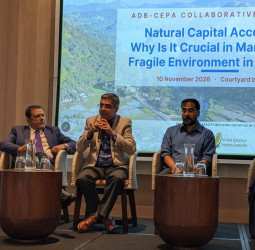
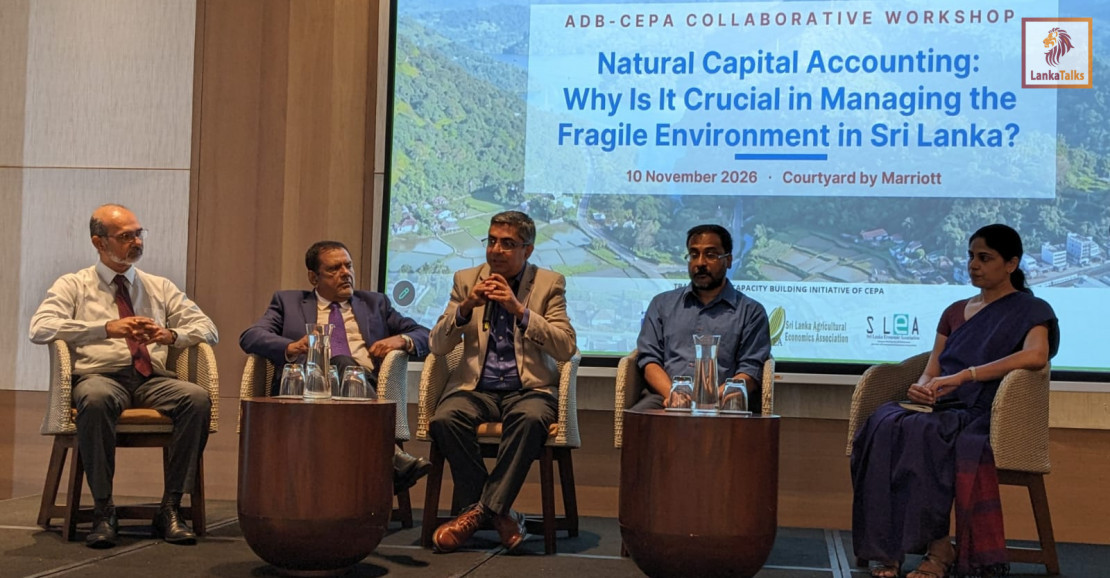
The issue was examined at the workshop ‘Natural Capital Accounting: Why Is It Crucial in Managing the Fragile Environment in Sri Lanka?’, held at Courtyard by Marriott Colombo under the patronage of ADB Country Director for Sri Lanka Shannon Cowlin. Policymakers, statisticians, economists and environmental specialists discussed how Natural Capital Accounting (NCA) could inform a phased national approach, with a proposed 2027 rollout and initial attention to upper watersheds and coastal and marine ecosystems.
Why GDP alone is not enough
Gross Domestic Product records economic output but does not, by itself, disclose whether development is depleting forests, weakening watershed protection or degrading coastal ecosystems. This can distort public investment choices: a project may contribute to measured output while imposing unrecognised costs through soil erosion, water insecurity, flooding or declining ecosystem services.
NCA, using the United Nations System of Environmental-Economic Accounting (UN-SEEA), can address this information gap by combining conventional economic statistics with accounts of environmental assets, their condition and the services they provide. It complements rather than replaces GDP. In Dr. Herath Gunatilake’s presentation, an estimate that 75% of economic activity in developing Asia approximately US$21 trillion depends on nature illustrated the economic importance of the issue.
Addressing the workshop, Shannon Cowlin said: “Sri Lanka’s natural resources are fundamental to its economic resilience, livelihoods and long-term development. Natural capital accounting provides an important opportunity to make the value of these resources visible in economic decision-making. By strengthening the evidence available to policymakers and investors, Sri Lanka can pursue economic growth while safeguarding the environmental assets on which its future prosperity depends.”
Turn environmental information into policy decisions
Dr. Herath Gunatilake, Senior Advisor to CEPA and former Director of ADB’s Environment and Safeguards Division, reviewed four decades of international methodological development and practical applications. His presentation identified political commitment, fragmented institutional mandates, data limitations, technical capacity and methodological consistency as obstacles to establishing usable accounts.
Commenting on the workshop, Dr. Gunatilake said: “Economic growth cannot be considered sustainable if the natural resources supporting that growth are continuously degraded without being accounted for. Natural capital accounting helps policymakers understand the relationship between economic activity and environmental sustainability. For Sri Lanka, developing credible accounts for watersheds and coastal ecosystems would provide an important foundation for better public investment, resource allocation and long-term economic resilience.”
For Sri Lanka, an operational starting point would be to establish baseline accounts for ecosystem extent and condition in selected upper catchments and coastal areas; measure priority services such as water regulation, erosion control, coastal protection and fisheries support; and publish consistent updates. A designated statistical lead, common data standards and cooperation between environment, finance, planning and sector agencies would be needed to ensure that the findings reach budget preparation, project appraisal and land-use decisions.
Dr. Gunatilake also drew on international cases illustrating the policy value of NCA. A study of China’s Guangxi river basin compared development and ecological-protection scenarios to inform geographically differentiated compensation for ecosystem services. Indonesia’s low-carbon development modelling used environmental-economic accounts to evaluate growth, employment, emissions and investment trade-offs. These experiences demonstrate decision-making tools, not outcomes that can automatically be transferred to Sri Lanka.
A phased roadmap, backed by institutions
Presentations by ADB representatives Joseph Mariasingham and Sumit Pokhrel addressed NCA initiatives and nature-positive investment, while Dr. Shamen Vidanage outlined related work by the International Union for Conservation of Nature. A panel involving the Ministry of Environment, Department of Census and Statistics, UNDP and professional economic associations considered the institutional and technical groundwork for national implementation.
The immediate policy priority is therefore not merely to produce another environmental report, but to build an accountable, regularly updated information system that influences expenditure and investment decisions. A phased programme, beginning with verifiable ecosystem baselines, inter-agency data sharing and tested pilot accounts,could help Sri Lanka identify where conservation delivers measurable economic benefits and where development is eroding the natural capital on which future growth depends.