



 Breaking News

 LankaTalks
 LankaTalks
 Mar 10 2026
 282
282The Financial Intelligence Unit of Sri Lanka Releases the Executive Summary of the National Risk Assessment on Money Laundering, Terrorist Financing and Proliferation Financing – 2024/25
Sri Lanka has successfully completed the National Risk Assessment (NRA) 2024/25 on Money Laundering (ML), Terrorist Financing (TF) and Proliferation Financing (PF), in collaboration with a total of 86 governmental organizations, regulatory bodies and private sector institutions. Around 200 experts from these institutions contributed to this mammoth national task. This is the country’s third NRA and under this assessment, it was aimed at identifying the ML/TF/PF risks in the country. The assessment highlights the most significant ML/TF/PF threats, vulnerabilities, and the overall risk faced by Sri Lanka.
The Financial Intelligence Unit (FIU) of the Central Bank of Sri Lanka (CBSL) functioned as the coordinator for the assessment under the guidance of the National Coordinating Committee (NCC) on Anti Money Laundering/Countering the Financing of Terrorism (AML/CFT). The assessment was conducted under 15 core areas , including ML threat, ML vulnerability, banking sector vulnerability, securities sector vulnerability, insurance sector vulnerability, other Financial Institutions (FIs) vulnerability, Designated Non-Finance Businesses and Professions (DNFBPs) vulnerability, TF risk, financial inclusion product risk, environmental and natural resource crimes risk, non-profit organizations risk, risk of legal persons, legal arrangements and beneficial ownership, risk of Virtual Assets (VAs) and Virtual Assets Service Providers (VASPs), tax crimes and PF risk.
This third NRA is significant for Sri Lanka, as it incorporates the following key features:
- The country’s first national risk assessment of PF, conducted alongside ML and TF risk assessments;
- Strong multi-stakeholder participation of experts from public and private sector institutions;
- The expanded scope covered 15 modules, including tax crimes risk and PF risk as new assessment areas;
- Consideration of global and regional ML/TF/PF risk contexts; and
- Use of a clear and standardized rating framework, including defined interpretations for risk, threat and vulnerability levels.
The national ML risk of Sri Lanka was determined by assessing: 1) the national ML threat; and 2) the national ML vulnerability. Sri Lanka’s overall national ML threat level was assessed as medium, primarily based on the major proceeds-generating unlawful activities (predicate offences). The country’s overall ML vulnerability was also rated as medium, taking into account both the national combating ability and sector-specific ML vulnerabilities. Accordingly, Sri Lanka’s overall national ML risk was rated as medium, consistent with the previous assessment.
Under the ML threat assessment, drug trafficking was identified as the most serious predicate offence, with the ML threat level increasing to high from the previous medium-high rating. It was followed by fraud, and customs related offences, including Trade-Based Money Laundering (TBML), which were assessed as medium-high. The threat level of bribery and corruption has decreased from a medium-high rating in the previous assessment to a medium level. This reduction is reflected by improved Corruption Perceptions Index (CPI) score, which increased from 32 in 2024 to 35 in 2025. Further, robbery, environmental and natural resource crimes, illegal, unreported and unregulated (IUU) fishing related unlawful activities, human trafficking and tax offences also recorded as having a medium level of ML threat. For the first time, violations under Excise Ordinance were assessed and rated as medium-low. Counterfeiting of currency continued to reflect a low ML threat level, consistent with the previous assessments.
Under the ML vulnerability assessment, national combating ability was assessed by considering many variables including effectiveness of ML crime definition, comprehensiveness of asset forfeiture laws, quality of FIU intelligence gathering and processing, capacity and resources for financial crime investigations, integrity and independence of financial crime investigators, capacity and resources for financial crime prosecutions, integrity and independence of financial crime prosecutors, effectiveness of domestic and international cooperation, and availability and access to beneficial ownership information. Further, under this assessment, ML vulnerability of financial and non-financial sectors was also considered.
By considering the ML threat to the financial and non-financial sectors and ML vulnerability of those sectors, ML risk was assessed.
Similar to the above ML aspects, country’s TF risk, threat and vulnerability were also assessed during the assessment. Accordingly, Sri Lanka’s national TF risk, a combination of TF threat and vulnerability, was assessed as medium-high, reflecting an increase from medium level in the previous assessment. This risk was driven by a rise in threat level to medium-high reflecting evolving threats from both extremist and separatist networks, supported by possible diaspora funding, digital radicalization, regional spillover risks, and the use of informal and emerging financial channels. Meanwhile, vulnerability remained unchanged at medium level.
The ML and TF risk across financial institutions and designated non-financial businesses and professions sectors as follows;
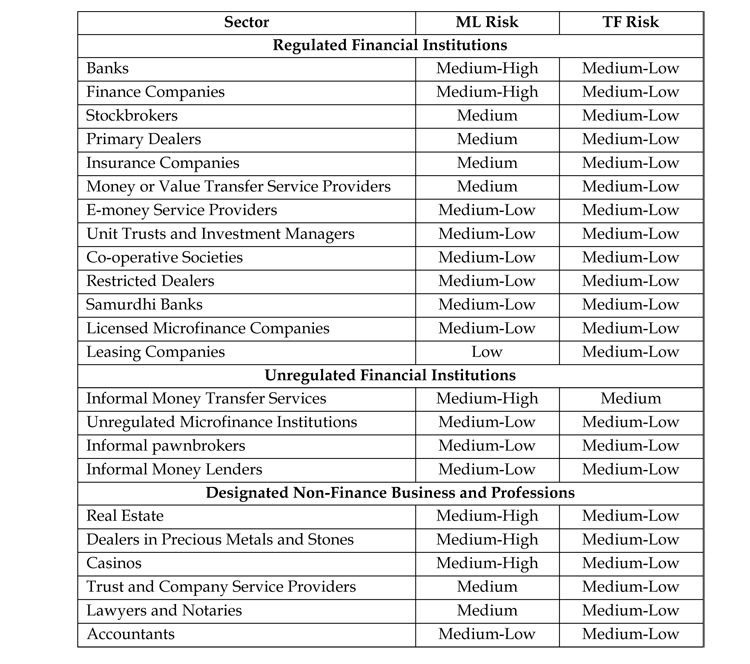
Further to the above, the NRA also evaluated ML/TF risks relating to legal persons (ML risk: Medium-High, TF risk: Medium) and arrangements (Medium), virtual asset service providers (Low to Medium), financial inclusion products/services (Low to Medium), and categories of non-profit organizations at risk of abuse for TF (Low to Medium).
In addition to the above, as stated earlier country’s first national risk assessment of PF was assessed and it was rated as medium, reflecting the combination of a globally significant threat environment and identified domestic vulnerabilities.
Based on the findings of the NRA, 15 key recommendations have been made. Accordingly, Sri Lanka’s National Policy on AML, CFT and Countering Proliferation Financing (CPF) will be updated for 2026 – 2030 period.
The Executive Summary of the NRA 2024/25 is available on the FIU website (Sri_Lanka_NRA_on_ML_2024_25_Executive_Summary.pdf).
This assessment is an important resource for both the public and the private sector stakeholders to better understand the country’s current ML/TF/PF risk profile and to strengthen their institutional risk mitigation strategies. By allocating more resources to mitigate the higher-risk areas, stakeholders can safeguard the integrity and stability of Sri Lanka’s financial system. Further, the Institutions covered under Section 33 of the Financial Transactions Reporting Act, No. 6 of 2006, are advised to incorporate the findings of the latest NRA into their institutional risk assessments.
The FIU extends its sincere appreciation to all public and private sector institutions that contributed to this national endeavor.
Source: Adaderana