Dilmah Genesis and LSE South Asia Centre convene global experts in Colombo to examine how advice, policy, and trust can strengthen entrepreneurial resilience in Sri Lanka’s post-crisis recovery
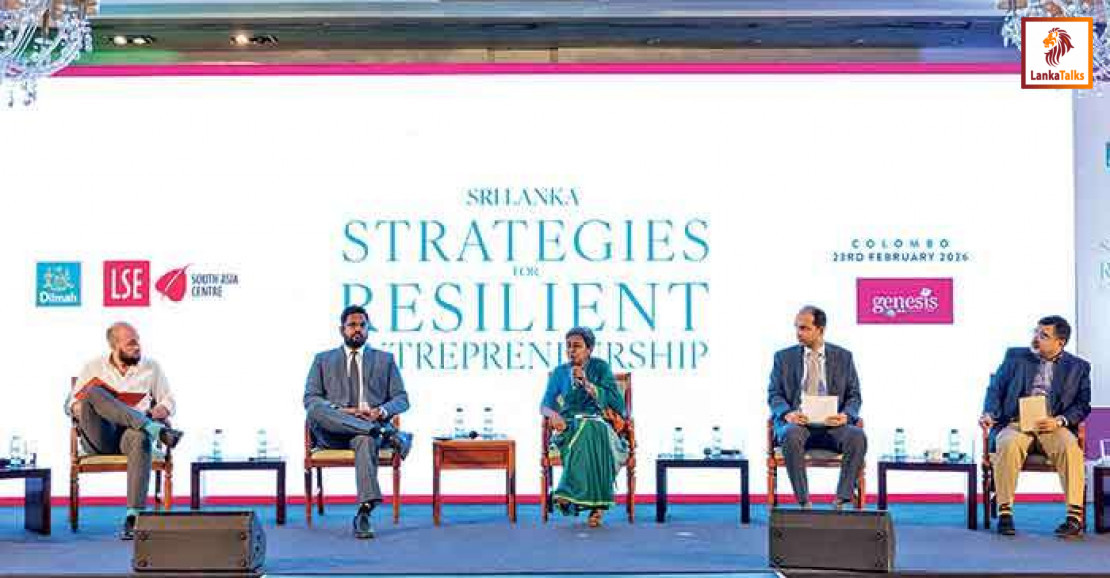
Sri Lanka’s recent economic stabilisation has offered a sense of relief but it has also raised an uncomfortable question: is stability the destination or merely the threshold? This tension framed a high-level workshop and Roundtable jointly convened by Dilmah, Genesis Dilmah Centre for a Sustainable Future and LSE South Asia Centre (London School of Economics and Political Science) in Colombo. It brought together academics, researchers, policy-advisers, practitioners, state and non-state actors to discuss what resilient entrepreneurship truly requires in a post-crisis economy.
Opening the discussion, Dilhan C. Fernando (Chairman and CEO of Dilmah, also an LSE alumnus), set out both a conviction and a challenge. Sri Lanka, he observed, possesses extraordinary entrepreneurial capability, proven repeatedly in resilience through decades of disruption and crises. Yet, this inherent strength has often been constrained by inadequate policy frameworks and fragmented support systems. What has changed, he noted, is the nature of value itself. Global consumers now define value through ethics, provenance, culture, sustainability, and trust — areas where Sri Lanka holds a natural advantage. At the same time, innovation, artificial intelligence, and shifting global markets have fundamentally altered the competitive landscape. The opportunity, therefore, is real, but so is the risk of being left behind without deliberate policy adjustment and institutional alignment.
That tension between promise and precarity was deepened by research presented by David Lewis, Professor of Anthropology and Development at LSE. Drawing on multi-year ethnographic research in Sri Lanka and Bangladesh, he argued that entrepreneurship support has long underestimated one of its most powerful tools: advice. While finance, training, and skills development dominate policy conversations, advice — understood not merely as technical instruction but as relational support — often determines whether small businesses survive or fail. The project (‘Ethnographic Solutions to Inequalities in South Asian Advicescapes’, funded by the Atlantic Fellows for Social and Economic Equity at LSE) showed that entrepreneurs rely heavily on informal advice networks rooted in trust, familiarity, and social obligation, while formal advisory systems remain sporadic, uneven, and disconnected from lived realities.
Building on this, Brunel University London Senior Lecturer Dr. Luke Heslop examined entrepreneurship at the micro level in low-income neighbourhoods of Colombo. His findings challenge the assumption that informal economies are unstructured or resistant to guidance. Instead, he showed that advice circulates through dense moral and social networks, shaping not only business decisions but entrepreneurs’ sense of what futures are possible. Formal advice, when delivered as one-off technical interventions, often clash with survival realities. Entrepreneurs do not reject advice out of ignorance, he argued, but selectively adapt it to protect fragile livelihoods. Effective support, therefore, must work with existing relationships rather than override them.
The policy implications of these insights were taken further by Centre for a Smart Future Co-Founder and Director Anushka Wijesinha. Reflecting on Sri Lanka’s ‘polycrisis’ — from the Easter attacks and the pandemic to the economic collapse — he stressed that entrepreneurs are not a single, homogeneous group. Crisis created new entrepreneurs as much as it tested existing ones, pushing households into survival-driven enterprises across Colombo and beyond. Yet, institutional responses, he argued, have been disproportionately narrow. Relief has relied heavily on financial instruments such as debt moratoria and concessional loans, often delaying problems rather than resolving them, while broader advisory and capability-building interventions have remained fragmented and under-resourced.
At the same time, Wijesinha pointed to important bright spots. Some public institutions adapted quickly, acting less like bureaucracies and more like relationship managers. Private-sector initiatives and development-partner programmes demonstrated that targeted advice, digital tools, and ecosystem coordination could help firms adapt and not just endure. The challenge now, he argued, is scale and coherence. For a country that frequently declares SMEs central to growth, enterprise support remains under-prioritised in policy design and fiscal strategy.
The conversation then widened to global comparisons on value chains and competitiveness through insights from LSE Doctoral researcher Animesh Jayant. Drawing parallels between India’s sugar industry and Sri Lanka’s tea and agricultural sectors, he illustrated how well-designed competition policies can drive quality upgrading across entire value chains. Evidence from India showed that when processors compete for supply, farmers benefit through higher prices, better services, and access to improved technology. Importantly, Jayant also highlighted how climate shocks, while disruptive, can also accelerate innovation when incentives are aligned — a lesson of particular relevance as Sri Lanka confronts climate volatility.
LSE South Asia Centre and Professor in the Department of Management Director Naufel Vilcassim, shared research from East Africa demonstrating that financial support alone rarely sustains small businesses. Instead, relational guidance — coaching, mentorship, and trust-based networks — proved decisive in determining whether micro-enterprises thrive or fail. He argued that Sri Lanka’s entrepreneurial potential could similarly be unlocked by investing not only in capital but also in human-centred support structures that build confidence and capability across communities.
Complementing this perspective, Expectation State Country Director (India) and Co-Director of the LSE Research and Education Foundation India Abhilash Puljal drew on global reform experiences in Rwanda, Estonia, South Korea, Vietnam, and Georgia. He emphasised that economic stabilisation alone cannot restore entrepreneurial confidence. Lasting transformation requires digitally enabled public infrastructure, diaspora engagement, and value-driven export strategies — lessons that resonate strongly with Sri Lanka’s post-crisis recovery ambitions.
Across disciplines and perspectives, a shared conclusion emerged. Stabilisation alone cannot unlock entrepreneurship-led growth. Finance without guidance is fragile. Policy without trust is ineffective. And resilience without institutional support risks exhaustion. What Sri Lanka requires now is not another short-term fix but a reimagining of enterprise support that places advice, relationships, quality upgrading, and confidence at its core.
By convening this dialogue, Dilmah in collaboration with LSE South Asia Centre framed a broader national question. How does a country move from surviving crises to shaping its future? The answer, discussed during the Roundtable sits in aligning policy with lived entrepreneurial realities, treating advice as infrastructure, and recognising that confidence is as critical as capital.
A White Paper incorporating the discussions, and policy suggestions, will be prepared for submission to relevant government authorities for action in due course; it will also be made available to anyone who may want to read it on the websites of Dilmah and LSE South Asia Centre.
Source: Daily FT






 Breaking News
 LankaTalks
 LankaTalks
 Mar 03 2026
 843
843