


 Breaking News
 Puvanya
 Puvanya
 Oct 16 2026
 52
52By Nishel Fernando
Sri Lanka’s best tourism years are still ahead, but the island must push hotel growth beyond Colombo and the southern coast, stitch its attractions into longer travel circuits and sharpen its pitch to Indian travellers to chase Thailand-style scale and Maldives-level yields, top executives of Hilton, Marriott International, Wyndham and Sterling Holiday Resorts said.
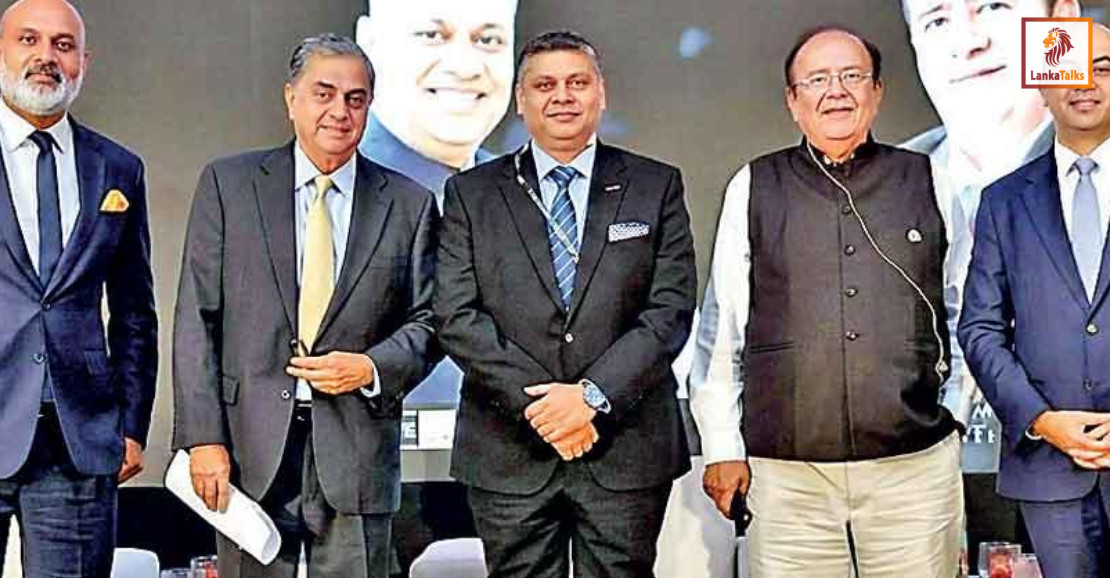
Speaking on the leaders’ panel at the fourth edition of the THINC Sri Lanka & Maldives conference at Hilton Colombo yesterday, moderated by Hotelivate Savills Founder Chairman Manav Thadani, the four hospitality chiefs were united on the island’s untapped breadth, though they parted ways on whether franchising or management contracts offer the better route to scale.
Marriott International Senior Vice President South Asia Kiran Andicot, who first visited Sri Lanka as a developer in 2006 and named it his absolute favourite holiday destination, acknowledged that the island had endured a spate of bad luck over the past two decades. Marriott operates just five hotels in the country today against 11 in the Maldives, a market he began covering at the same time.
Pointing to 11 consecutive quarters of positive GDP growth, Andicot nonetheless sounded upbeat.
“Fingers crossed, because I think the best time for Sri Lanka is yet to come,” he told the gathering.
He cautioned against treating the two Indian Ocean neighbours as a single play, arguing that Sri Lanka’s runway over the next 10 to 15 years lies in following mature markets such as Thailand, which draws upwards of 30 million tourists, as well as fast-growing Vietnam.
“We shouldn’t put Sri Lanka and Maldives in the same bucket. They›re two very different markets,” he insisted.
With Courtyard, Sheraton and an affiliation with ITC already anchoring its presence in Colombo, Marriott sees the strongest prospects in experiential resorts, collection brands, wellness and smaller boutique properties.
‘‘The real potential and the real beauty of Sri Lanka lies outside of Colombo,’’ Andicot observed, adding that the island needed “more representation, but thoughtful representation” that knits its beaches, wildlife, cultural triangle and hill country into a holistic guest experience.
Meanwhile, Hilton Senior Vice President and Regional Head South Asia Zubin Saxena, whose company recently restructured its regions to bring Sri Lanka under South Asia alongside India, Nepal and Bangladesh, believes the destination has barely tapped its geographical breadth. With four properties currently operating in the country Hilton Colombo, Hilton Colombo Residences, DoubleTree by Hilton Weerawila and Hilton Yala and more in the pipeline, he noted that hotel supply remains heavily clustered in obvious pockets like Colombo and Galle.
“Sri Lanka as a destination is yet to spread its wings,” Saxena remarked, seeing strong potential across Hilton’s brand ladder, from Conrad in luxury and DoubleTree in the upscale segment to lifestyle collection brands such as LXR and Curio, which allow independent local properties to plug into a global reservation system.
He also called for a sharper destination marketing strategy, conceding that even as a frequent visitor he struggled to see what lay beyond the island’s best-known sites.
“It is not clear what, beyond the obvious, are the incremental things that I can add to my itinerary in this destination when I visit here,” he explained, adding that he wanted to see Sri Lanka “become more and more visible” in India, along with better road connectivity to open up harder-to-reach regions such as the east coast.
“I would prefer roadways more than airports, because when you build a road, you actually open up a destination as well,” he said.
Sterling Holiday Resorts Managing Director and CEO Vikram Lalvani put a figure on that untapped potential, noting that Sri Lanka and the Maldives each welcome roughly 2.5 million tourists a year, yet Sri Lanka earns around US$ 3 billion from them while the Maldives generates close to US$ 5 billion, a gap he attributed to the heavy premiumisation in the archipelago.
“Sri Lanka has this tremendous opportunity, not to create new destinations, but actually to connect existing destinations,” Lalvani argued. “The circuit connection is what Sri Lanka needs.”
He noted that holidaymakers in Sri Lanka currently stay an average of five nights, and reasoned that packaging two or three destinations across beaches, hills and wildlife could stretch stays to eight or nine nights, helping bridge the US$ 2 billion earnings gap with the Maldives. Taken at face value, Lalvani’s figures put Sri Lanka’s current yield at roughly US$ 1,200 per visitor against US$ 2,000 in the Maldives. In others, this means Sri Lanka would need about 6.7 million arrivals at current yields to hit its US$ 8 billion earnings target by 2030, compared to just four million if it matched Maldivian per-visitor spend.
Lalvani, whose company operates 85 resorts and hotels across 70 destinations in India, also pointed out that one in every four tourists arriving in Sri Lanka is Indian, creating a natural “tourism osmosis” between the two countries. He urged that the island be promoted as a 365-day destination by leveraging the alternating seasons of the east coast and the south-west.
In the Maldives, «the opportunity there is to protect its premiumisation. The opportunity here is connection,” he summed up.
Wyndham Hotels & Resorts Market Managing Director Eurasia Rahool Macarius echoed the India thesis, describing Sri Lanka as a natural extension of the Indian market, where outbound travel is running at around 30 million a year, which means Sri Lanka’s roughly 625,000 Indian arrivals capture barely 2 percent of that outbound pool. While spotting an opportunity for upper mid-scale resorts in the Maldives, Macarius urged Sri Lanka to identify tier-two and tier-three cities to drive its next wave of hospitality growth beyond flagship hubs like Colombo, where the group is represented by Ramada by Wyndham.
“You cannot confine a country or a destination to a certain class. It has to be tasted by everyone,” Macarius contended, making the case for franchising as the fastest route to scale on the grounds that more than 70 percent of international hotel brands globally are franchised.
Lalvani took the opposite view, arguing that management contracts with a strong risk-reward structure are essential in a market where operators must control the end-to-end guest experience across connected circuits. Saxena and Andicot both noted that direct management remains their primary growth vehicle in Sri Lanka, though each expressed openness to franchise partnerships with established local operators that already run high-quality assets.
Asked in a closing rapid-fire round to choose between Sri Lanka and the Maldives, Andicot and Lalvani picked Sri Lanka, Saxena answered “both”, and Macarius opted for the Maldives first, followed by Sri Lanka.