


 Breaking News
 Puvanya
 Puvanya
 Oct 06 2026
 38
38The government last week signed agreements securing US$ 22.44 million in grants from the European Union and Japan alongside a US$ 35 million concessional loan from the Asian Development Bank (ADB) for a rooftop solar and grid modernisation project that introduces virtual net metering to the country for the first time, the Finance Ministry said.
The grants, comprising Euro 15.4 million (US$ 16.94 million) from the EU and US$ 5.5 million from the Japan Fund for the Joint Crediting Mechanism, are equivalent to 64 percent of the loan and meet nearly 28 percent of the US$ 80.5 million project cost. Both are administered by the ADB, which approved the package in June.
The loan carries an interest rate of 2 percent a year over a 25-year term, including a five-year grace period, as per ADB project documents. It would be on-lent to Electricity Distribution Lanka (EDL) and Lanka Electricity Company (LECO), which receive US$ 28 million and US$ 7 million respectively and bear the foreign exchange risk. The two utilities are also expected to contribute the remaining US$ 23.06 million.
The EU grant would fund 25 MW of aggregated rooftop solar, with 20 MW in EDL areas and 5 MW in LECO areas. The output would be credited to the bills of small and medium-scale entrepreneurs who lack the roof space or financing to install their own systems. At least 600,000 small businesses and organisations, largely unsubsidised general purpose consumers using less than 180 units a month, stand to benefit on a rotational basis.
The targeted consumers account for about 12 percent of electricity users but only 2.5 percent of consumption, and pay above the estimated cost of supply without any subsidy. The EU grant would also fund a solar-powered renewable energy training facility, which is expected to train at least 100 students a year from low-income families.
However, the bulk of the spending is on the grid, with network modernisation accounting for US$ 54.8 million of the US$ 71.5 million base cost, or 77 percent. The ADB expects the upgraded network to absorb about 500 MW of new renewable capacity, 20 times what the project itself installs.
Under the project, EDL would roll out smart metering, a distributed energy resource management system and distribution control centres, which the ministry expects to speed up restoration of supply after outages. The solar plants would also carry control capability allowing the National System Operator to manage their generation in line with network constraints.
Meanwhile, the Japanese grant goes entirely to LECO, which plans to install battery energy storage at distribution transformer level and low-loss conductors across 140 km of its network. With a particular focus on Negombo, the utility expects to connect more high-capacity commercial and industrial loads while absorbing higher levels of renewable energy. The US$ 5.5 million grant meets 27 percent of LECO’s US$ 20.3 million component, and the ADB sees the battery storage and low-loss conductors as technologies that could be replicated elsewhere in the network.
The solar installations are scheduled between the third quarter of 2027 and mid-2028 under a project running until 2030.
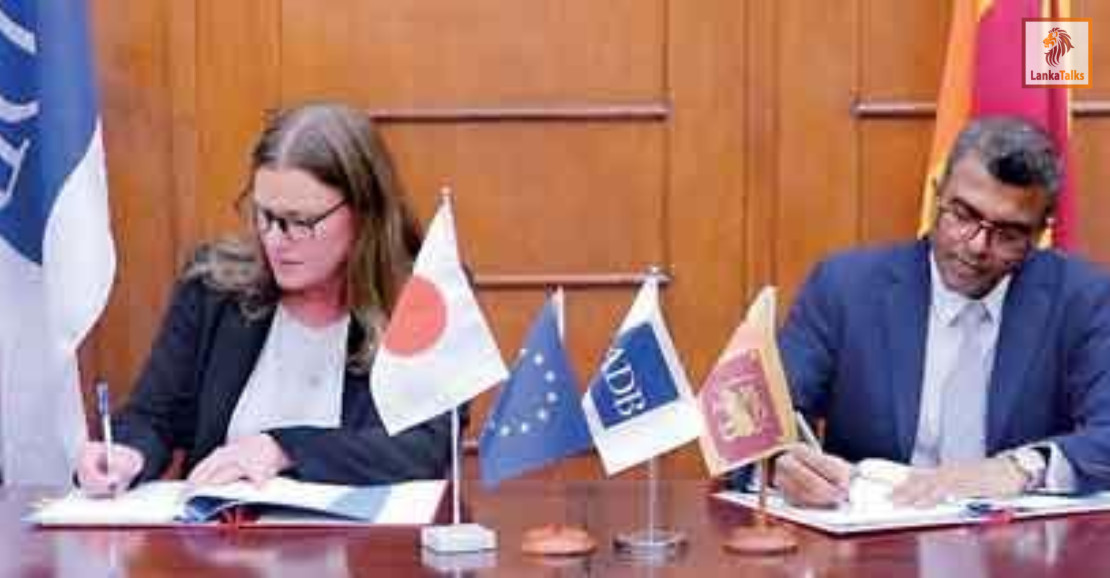
EU Delegation Head of Partnerships Virginie Lafleur-Tighe and Japanese Embassy Deputy Chief of Mission Naoki Kamoshida were present at the signing at the Treasury, where Finance Ministry Secretary Dr. Harshana Suriyapperuma and ADB Country Director for Sri Lanka Shannon Cowlin signed the agreements.