



 Breaking News
 Afrin
Afrin Afrin
Afrin Jan 05 2026
 798
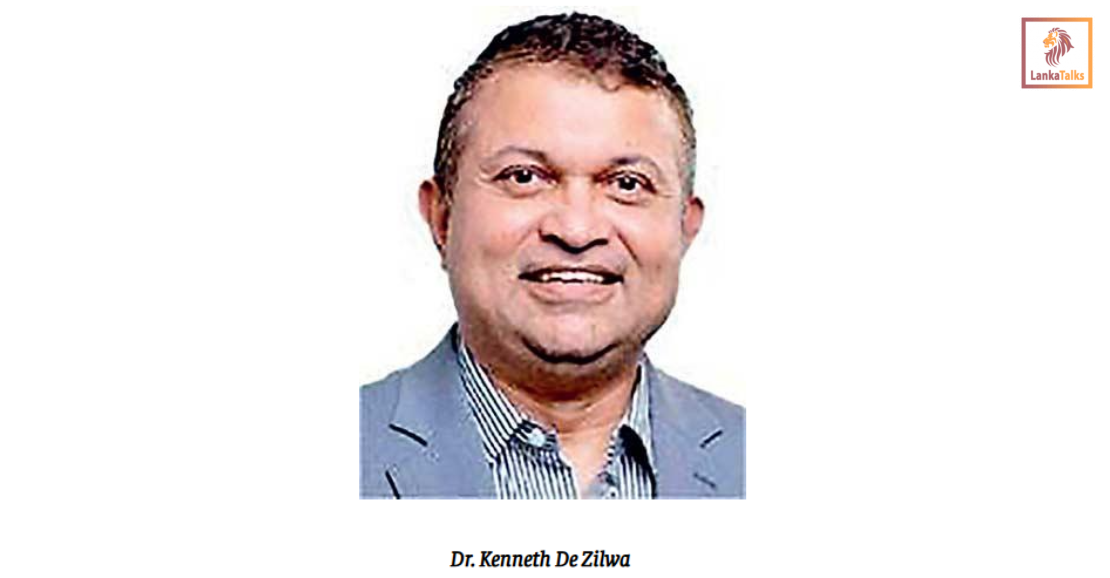
798Lanka Rating Agency CEO Dr. Kenneth De Zilwa has launched a scathing critique of Sri Lanka’s economic trajectory under the International Monetary Fund (IMF) programme, arguing that the widely touted “stability” is a facade masking a catastrophic deterioration of the national balance sheet.
In a detailed assessment of the country’s debt dynamics through to early 2026, Dr. De Zilwa cautioned that the sheer scale of debt accumulation driven by interest costs rather than investment, threatens to deliver a “death blow” to the island nation’s economy.
Dr. De Zilwa pointed to the explosive growth of domestic government debt as the most glaring evidence of policy failure. According to the data highlighted in his remarks, domestic debt, which stood at approximately Rs. 9 trillion in 2020, had more than doubled to nearly Rs. 20 trillion by June 2025. He contends that this surge occurred despite a painful domestic debt restructuring (DDO), aggressive tax hikes, and deep spending cuts.
“A doubling of domestic debt in a stagnant economy is not ‘progress’, it is balance-sheet ‘deterioration’ and ‘death’,” Dr. De Zilwa noted. He argued that this borrowing was not utilised for productive development but was instead necessitated by the skyrocketing cost of debt servicing. He maintained that high interest costs and the rollover pressure of debt servicing have forced the state to mobilise local savings just to pay off interest, effectively crowding out private credit and tying the banking sector’s fate entirely to sovereign risk.
The situation on the external front appears equally grim. Dr. De Zilwa highlighted that foreign debt had ballooned from roughly Rs. 15 trillion in 2020 to Rs. 28 trillion by December 2024. This increase has materialised despite the country being in default and undergoing restructuring. He attributed the rise to currency depreciation, accumulated interest arrears, and new borrowings, including USD 5.4 billion in external funds absorbed during the IMF programme period. Crucially, he observed that these inflows have done nothing to reverse the negative trajectory of the country’s Net International Investment Position (NIIP).
The ultimate proof of the national balance sheet’s collapse, according to Dr. De Zilwa, lies in these NIIP figures. In 2020, the NIIP was already negative at around USD 47.6 billion. By 2024, it had deteriorated further to roughly negative USD 53.4 billion, reflecting rising external liabilities and minimal accumulation of foreign assets.
Dr. De Zilwa further criticised recent policy decisions that facilitated non-essential outflows, specifically pointing to approximately USD 2 billion in vehicle imports. He argues that in an economy with stagnant external earnings, such outflows merely compound liabilities without adding productive capacity, leaving the economy more dependent and fragile.
Dr. De Zilwa’s concerns regarding the structural flaws of the IMF-led recovery are not isolated. Similar sentiments have been echoed by political economist Dr. Ahilan Kadirgamar, who has consistently warned that the Domestic Debt Optimisation (DDO) process places a disproportionate burden on domestic savings. He has argued that the strategy effectively utilises the savings of the working class to bail out external creditors, leading to a “dispossession” of local wealth without resolving the underlying solvency crisis.
Furthermore, veteran economist Dr. Howard Nicholas has long argued that the current policy framework addresses only short-term liquidity issues while ignoring the fundamental need for industrialisation. He contends that high interest rates and austerity measures are systematically hollowing out the real economy, destroying the production and export capacity required to sustainably service debt. These experts collectively argue that without a shift towards a production-based economy, the current ‘stabilisation’ is merely a holding pattern that leaves the nation more indebted and vulnerable than before.
“The IMF’s headline ‘stability’ masks the reality: the national balance sheet is weaker, private-sector profitability is crushed, capital formation has collapsed, and the country is more indebted than ever,” Dr. De Zilwa asserted. His remarks suggest that without a fundamental pivot from debt-servicing austerity to growth-oriented strategies, the current “stability” may effectively result in a permanent loss of Sri Lanka’s market share.
Source : DailyMirror