


 Breaking News
 Tracy
Tracy Tracy
Tracy Dec 15 2025
 1462
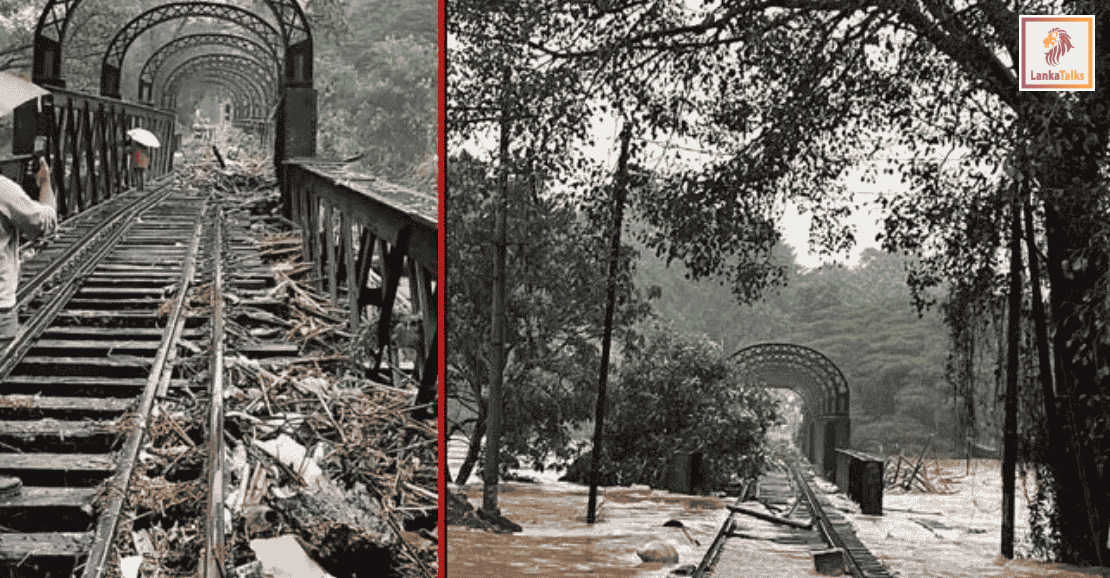
1462Sri Lanka’s railway system has been severely damaged by Cyclone Ditwah, leaving only two lines operating in the aftermath of the disaster, according to Sri Lanka Railways. While notable economic implications exist, with the impact to the system, analysts highlight the need for coordinated efforts, using this as an opportunity to rebuild better and modernise the railway system.
Based on the latest updates, Sri Lanka Railways announced that 16 main-line services would operate from Wednesday (10) onwards. These trains will operate from Colombo Fort to Rambukkana, Maho, Kurunegala, Ganewatte, and Polgahawela.
An opportunity to modernise
Speaking to The Sunday Morning Business, University of Peradeniya (UOP) Department of Economics and Statistics Professor Wasantha Athukorala noted the significance of the transport sector in running the economy.
With 278 km of railway track exposed to the cyclone, along with 35 railway bridges and more than 480 road bridges across the country, he stated that the overall scale of damage was severe, with both goods transport and passenger transport heavily disrupted. He added that certain areas no longer had usable roads, adding that damage in certain locations and railways was substantial.
However, Prof. Athukorala said that recovery, if properly operationalised, would likely take six months to one year, provided that work proceeded continuously and under a proper plan, with significant funding allocated. He emphasised that the transport sector played a central role in the economy, adding that delays in repair would affect both freight movement and passenger mobility.
On immediate priorities for rebuilding the transport system, he said that Sri Lanka required both short-term and long-term measures. In the short term, he said the Government must allocate funds immediately to restart damaged road and rail systems. In the long term, he stressed that the situation should be treated as an opportunity to modernise the country’s transport infrastructure.
Prof. Athukorala further observed that other countries had significantly more developed road and rail systems, including electrified and express railway networks, while Sri Lanka continued to operate with outdated systems and dated technologies. He also noted that countries increasingly invested in new technologies and were able to build transport systems that minimised disruptions from landslides and similar risks.
Further, he stated that modern technology should be used to develop a railway system that connected all major cities, noting that the current circumstances, combined with increased foreign assistance, provided an opportunity to update the country’s transport network.
Coordinated effort required
The Sunday Morning Business also spoke to former President of the Institution of Engineers Sri Lanka and former General Manager of Sri Lanka Railways Eng. Priyal De Silva, who led the rehabilitation and recovery project of Sri Lanka’s then tsunami-affected railway system in less than two months.
De Silva discussed several solutions based on his observations in two specific locations: the bridge over the Mahaweli in Peradeniya, and the damaged segment of railway between Ulapane and Nawalapitiya. He added that reports had been submitted to relevant authorities.
He explained that the Peradeniya Bridge had sustained significant structural damage causing it to shift out of alignment, which made running services under such conditions unsafe. He noted that an immediate soil investigation was required to determine why the pier had tilted.
Depending on the soil investigation, repairs could involve underpinning the existing foundation and stabilising it, allowing the bridge to be realigned. If this method is feasible, repairs can be completed in one-and-a-half to two months, enabling services to restart within two to three months. However, if the bedrock is too deep or the repair cost too high, service restoration will take longer.
De Silva stressed that the economic implications of the service disruption must also be properly assessed. With no rail transport between Peradeniya and Kandy, commuters have no choice but to rely on road transport, causing congestion along the Kandy road.
He also pointed out that the railway usually carried around 80% of passengers travelling to Kandy during the Esala Perahera period, adding that it was uncertain as to whether road transport alone could manage this volume.
Thus, he stated that if economic loss exceeded the cost of repairing the bridge, repairs should proceed. However, if repair costs surpass the calculated economic loss, the construction of a new bridge will be justified.
De Silva added that constructing a new bridge parallel to the existing bridge to enable a double track would take at least one-and-a-half to two years, as the work would involve completing foundations in the river and importing the superstructure from abroad. Once the new line is connected, the existing bridge can later be removed and replaced in the same manner.
He also pointed to where a major washaway had affected the segment between Ulapane and Alawwa. Stabilisation of all affected levels will have to be carried out by the National Building Research Organisation (NBRO). However, since the NBRO’s work could take four to five months, delaying rail operations entirely until completion is likely to impose further economic losses.
As a temporary measure, De Silva noted a proposal made for rebuilding the railway embankment with two or three large culvert openings, allowing water and earth to pass through during further slips. This, he said, would require taking a calculated risk in consultation with the NBRO.
Commenting on broader priorities for rebuilding the damaged railway system, he noted that the main line was currently operational only up to Ambepussa, especially due to a major culvert failure and a washaway near Alawwa. Once these repairs are completed, trains should be able to run up to Rambukkana, and possibly up to Mahawa on the other line. He added that the Balana section remained inaccessible due to the lack of a motorable road for transporting rubble, which meant that repairs would have to be carried out using the railway alone.
De Silva noted that railway staff were already addressing many of these issues along the Maho-Anuradhapura, Puttalam, Batticaloa, and Trincomalee lines. With the challenges associated with the upcountry tracks, he urged the need for coordinated support from several relevant networks in order to attend to the damaged lines.
Commenting on the time needed to restore the entire network, the former General Manager of Railways said that it was difficult to provide an exact timeframe. His initial estimate was that, with immediate involvement of the relevant Government agencies and continuous coordination with the Railways Department, the full network could be restored within six to seven months.
However, he stated that partial services could resume earlier in several sections. According to him, the Government remains attentive to the transport difficulties faced by the public and is likely to prioritise reopening lines as soon as possible.
Prioritising technical assessments
According to a United Nations Development Programme (UNDP) report released on the impact of the weather event, over 278 km of Sri Lanka’s railroad system have been exposed to cyclone-related flooding, including 35 railroad bridges nationwide.
Although this figure reflects only flooding, other hazards – such as localised debris, landslides, or damage to a single bridge – can also disrupt operations, meaning that even relatively small obstructions can render long stretches of railway non-operational. Railway exposure limits mobility and the capacity of affected populations to access key services and infrastructure.
University of Colombo (UOC) Department of Economics Professor Lalithasiri Gunaruwan noted that while the damage was extensive, this could be leveraged nationally, economically, and technically as an opportunity, especially for young engineers to gain experience and to build expertise and innovation. He added that, at this point, the spirit of recovery needed to be enhanced across the country in the aftermath of the disaster.
“For this, we need to execute proper technical planning, identifying technological alternatives, followed by proper economic evaluations based on cost-benefit comparisons. Thus, proper technical solutions must be prioritised.
“As the General Manager of Railways at the time, I initiated the double tracking of the Peradeniya-Kandy railway line in 2008. While the issue has taken close to 18 years to emerge, it could now be an opportunity to think of a double bridge,” he added.
Source: The morning