


 Breaking News
 Krishani
 Krishani
 Oct 12 2026
 9
9Central Bank of Sri Lanka (CBSL) research found that inflation above 7% negatively affects economic growth while showing no clear growth advantage from inflation substantially below 5%, officials told a panel discussion on 9 October
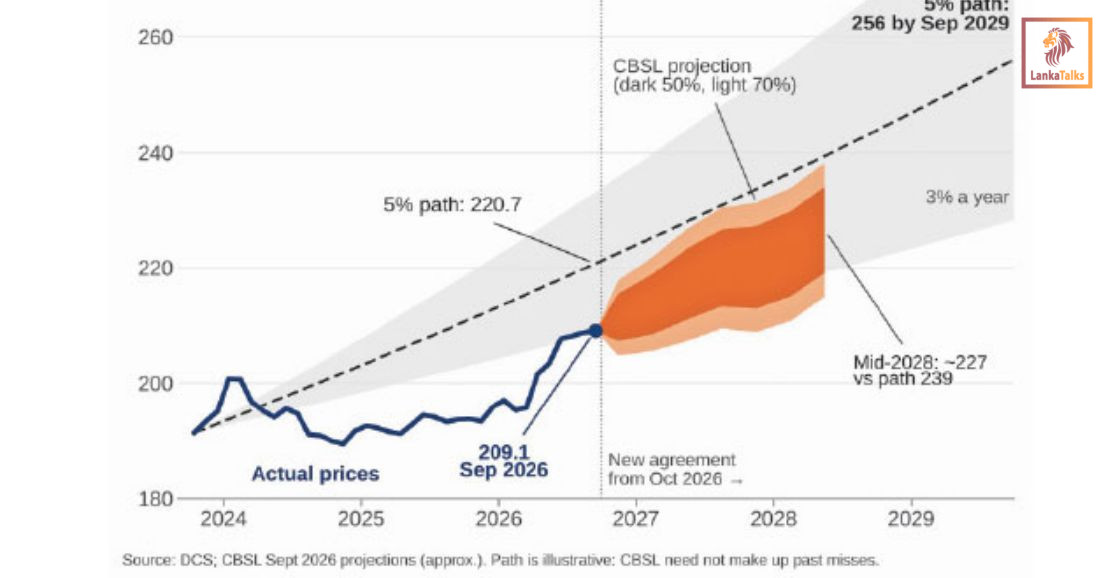
The findings formed part of the Bank’s first scheduled review of its inflation target under the Central Bank Act of 2023. An agreement signed on October 1, retained a 5% target for another three years, measured by year-on-year headline inflation in the Colombo Consumer Price Index. CBSL’s Economic Research Department Senior Economist and Head of the Modelling and Forecasting Division Dr V.S. Jayawickrema said threshold regression analysis found inflation above 7% adversely affected GDP growth. Estimates from the Bank’s Quarterly Projection Model showed the gap between actual and potential economic output narrowing when inflation was around 5%, a finding supported by alternative output-gap measures.
An examination of Sri Lanka’s historical inflation, excluding exceptional periods, also placed its midpoint near 5%. “Empirically, we found no clear growth advantage in having an inflation target, or an inflation level, well below 5%,” Dr Jayawickrema said. Director of Economic Research Dr Lasitha Pathberiya said approximately 50 countries operated inflation-targeting frameworks, of which 15 targeted 2%; 13 of those were advanced economies. Emerging-market targets generally ranged from 3% to 6%, with around one-third at 5% or higher.
Pathberiya said moving from a 5% to a 2% target would reduce steady-state nominal GDP growth by about three percentage points, affecting measures including public debt relative to GDP. Achieving the lower target would require tighter monetary policy and higher interest rates, particularly after supply shocks. Dr Jayawickrema also cited international research indicating that reducing inflation by one percentage point can cost developing and emerging economies approximately 0.5% to 2–3% of output
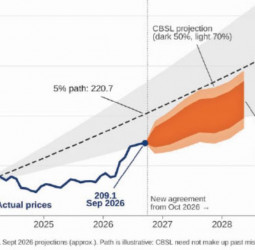
The review came as headline inflation reached 8% in August and September, up from 2.2% in March. Pathberiya attributed the increase principally to energy-price pressures arising from the Middle East conflict, noting diesel prices rose 40% between March and August. CBSL increased interest rates by one percentage point in May and held them at its latest review, regarding the shock as temporary.
Assistant Governor Dr P.K.G. Harischandra said Sri Lanka needed a credible record of achieving its target, anchored inflation expectations, stronger fiscal and external buffers, and reduced exposure to volatile food and energy prices before adopting a lower target. “Low inflation is the destination, not the vehicle,” he said.
The 5% figure remains a point target, not a 3%–7% target range. Inflation outside those limits for two consecutive quarters requires CBSL’s Monetary Policy Board to report to Parliament through the Finance Minister. (TP)