

 Breaking News
 A.R.B.J Rajapaksha
 A.R.B.J Rajapaksha
 Mar 16 2026
 543
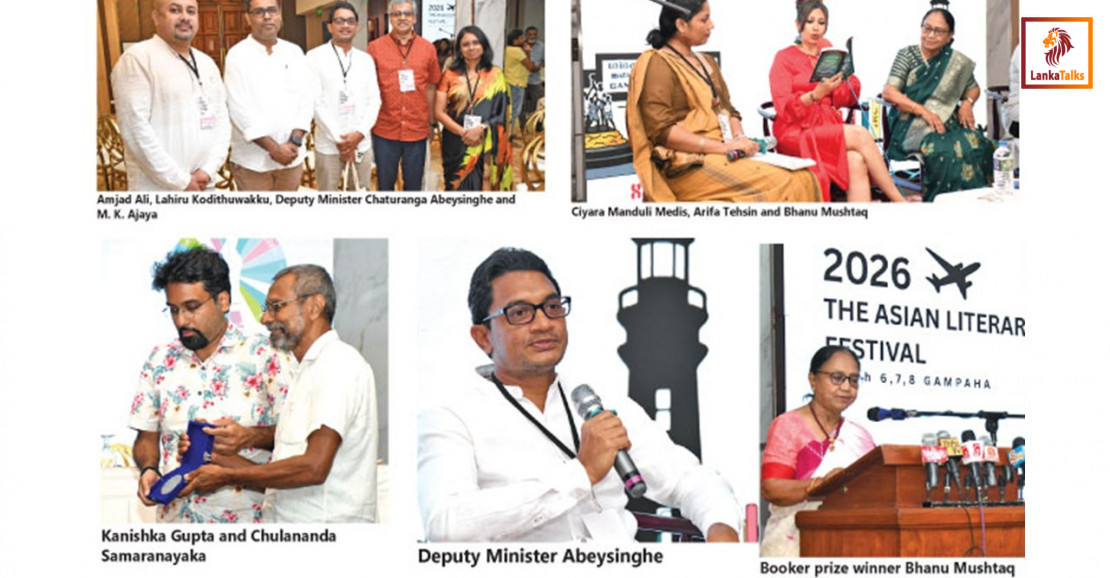
543When the curtain fell on the Asian Literary Festival (ALF) Gampaha 2026 on the evening of March 8, the city of Gampaha had been irrevocably changed.
Over three days of celebration – spanning literature, cinema, art, and culture – the festival had written a new chapter not only for Gampaha, but for Sri Lanka’s place in the global literary imagination.
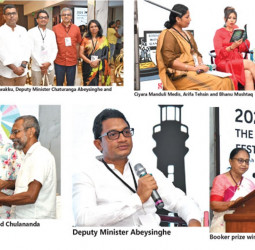
Held at Wet Water Resort from March 6-8, the third edition of the Asian Literary Festival brought together 157 authors — local and international — across 47 panels conducted in Sinhala, Tamil, and English.
The breadth and inclusivity of that programming has led organisers to describe it as the most inclusive literary festival ever held in Sri Lanka, a claim that is difficult to dispute.
A festival unlike any other
What set ALF Gampaha apart from the outset was its foundational principle: literature is not a luxury. True to that conviction, the entire festival was free and open to the public — making it the only 100 percent free international literary festival in Sri Lanka.
In an era when cultural events are increasingly gatekept by ticket prices and exclusivity, ALF’s open-door ethos represented a quiet but decisive act of democratisation.
The festival’s programming reflected the same spirit. Panels ranged across the full spectrum of literary and creative discourse, including The Architecture of Brevity on the short story form, The Voices of South Asia, Tamil Literature in the 21st Century, Literary Futures Beyond Commonwealth Frameworks, Culture as Capital: Creative Expression for Sustainable Development, The Creative Economy of South Asia, and Mind, Body, and the Writing Life, among many others. Sessions in all three languages ensured that no community was left at the margins.
The ALF Film Festival ran in parallel, screening a curated selection of South Asian cinema including Panthu, Thattha, Tears of Ceylon, and Vanni Mayil. For younger audiences, the Kipenzi ALF Kids Festival offered storytelling, drawing, origami, and interactive workshops — embedding a love of literature from the earliest age.
A gathering of global voices
The festival’s international dimension was impossible to miss. Among the most celebrated attendees was Bhanu Mushtaq, winner of the International Booker Prize 2025, whose presence lent the festival both prestige and warmth.
The inauguration of the festival was marked by the launch of the Sinhala translation of ‘Heart Lamp’, her celebrated short story collection, with Mushtaq in attendance — a moment that drew the largest audience of the opening evening.
Authors around the world joined their Sri Lankan counterparts on stage, producing the kind of genuine cross-cultural exchange that literary festivals, at their best, make possible. The fusion of voices, languages, and traditions gave the festival an atmosphere that felt less like a scheduled programme and more like a living, breathing conversation across borders. Because of the West Asian conflict a majority of the authors coming from Europe could not come this time, and they are rescheduled for the next edition.
A developmental vision
ALF Gampaha 2026 was notable not only for what it celebrated, but for the philosophy underpinning it. Unlike commercial literary festivals, ALF approaches culture as a tool for development — a vehicle for social change, community empowerment, and the construction of a more equitable public sphere.
That vision is inseparable from the man who conceived it. Pramudith D. Rupasinghe, the Sri Lankan author and humanitarian who founded the Asian Literary Festival, has long argued that literary gatherings must be held to a higher standard of purpose. “I see literary festivals differently as a development worker,” he has said. “They should be sustainable, and grounded in approaches that are rooted in systematic community engagement.”
It is a conviction that shaped every dimension of the Gampaha edition — from the decision to keep the festival entirely free, to the deliberate inclusion of all three of Sri Lanka’s literary languages, to the careful curation of panels that speak to lived realities rather than literary fashion alone.
That developmental lens was not lost on attendees or observers, many of whom described the festival as unlike anything they had previously encountered in Sri Lanka.
Gampaha on the global literary map
The morning of March 9 found Gampaha beginning to process what had just taken place. The city is now home to a literary festival with a genuinely global footprint — present on every continent, and the largest literary ecosystem in the country.
The Asian Literary Festival was launched in Brussels, the capital of the European Union, where it became the first Asian literary event ever held in the city. The second edition followed in Bhubaneswar, in the Indian state of Odisha. Gampaha marks the third.
The series continues with ALF Nairobi, scheduled from May 28-30 at the National Museum of Kenya — the festival’s African chapter. The next Gampaha edition is already confirmed from February 5-7, 2027.
In three editions, ALF has built something rare: a literary movement that travels, that listens, and that opens its doors without charge. For Gampaha, the festival’s conclusion is not an ending. It is, by any measure, a beginning.
Source - Sunday Observer