

 Breaking News
 A.R.B.J Rajapaksha
 A.R.B.J Rajapaksha
 Feb 23 2026
 543
543Sri Lanka’s labour market is showing early signs of recovery, with more people returning to work and employment levels gradually improving, according to official data shared with The Sunday Morning Business by the Department of Census and Statistics.
This data, released following a formal request by The Sunday Morning Business, shows that labour force participation rose to 49.9% in the third quarter of 2025 (July–September), up from 46.9% in the corresponding quarter of 2024 and 49.3% in the second quarter of 2025, pointing to a slow but steady normalisation after several years of economic disruption.
More Sri Lankans entering the workforce
The economically active population stood at approximately 8.47 million people in 2025, with men accounting for 63.3% and women 36.7%. Female labour force participation rose to 33.9% from 29.4% a year earlier, suggesting a gradual return of women to economic activity as conditions stabilised. Male participation remained significantly higher at 68.6%.
In contrast, Sri Lanka’s inactive population remained almost equal in size at 8.49 million, with women comprising over 71% of the total.
A long-standing structural problem
Placing the figures in historical context, University of Colombo (UOC) Professor Emeritus of Sociology Siri Hettige said that the labour market trends reflected deeper structural weaknesses in Sri Lanka’s economy.
“Employment depends on the structure of the economy,” he told The Sunday Morning Business. “And our economy is not sufficiently productive.”
Prof. Hettige noted that agriculture once formed the backbone of employment, particularly in the decades following independence, when irrigation and settlement schemes expanded cultivation across the country. However, both the colonial and post-independence economies remained heavily dependent on exporting primary commodities while importing manufactured goods.
From industrialisation to deindustrialisation
Attempts at industrialisation after independence led to the creation of State-led enterprises in textiles, fertiliser, cement, sugar, steel, and pharmaceuticals. However, rapid population growth and slower economic expansion generated persistent unemployment pressures.
According to Prof. Hettige, economic liberalisation after 1977 reversed many of the previous gains. “Many of the industries we had built simply disappeared,” he said, pointing to widespread deindustrialisation and the collapse of domestic manufacturing.
The rise of irregular and precarious work
The consequence, Prof. Hettige argued, has been the dominance of irregular employment. Only a minority of Sri Lankan workers now hold regular salaried jobs with social protection such as pensions or provident funds.
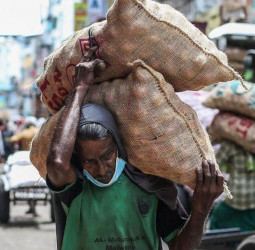
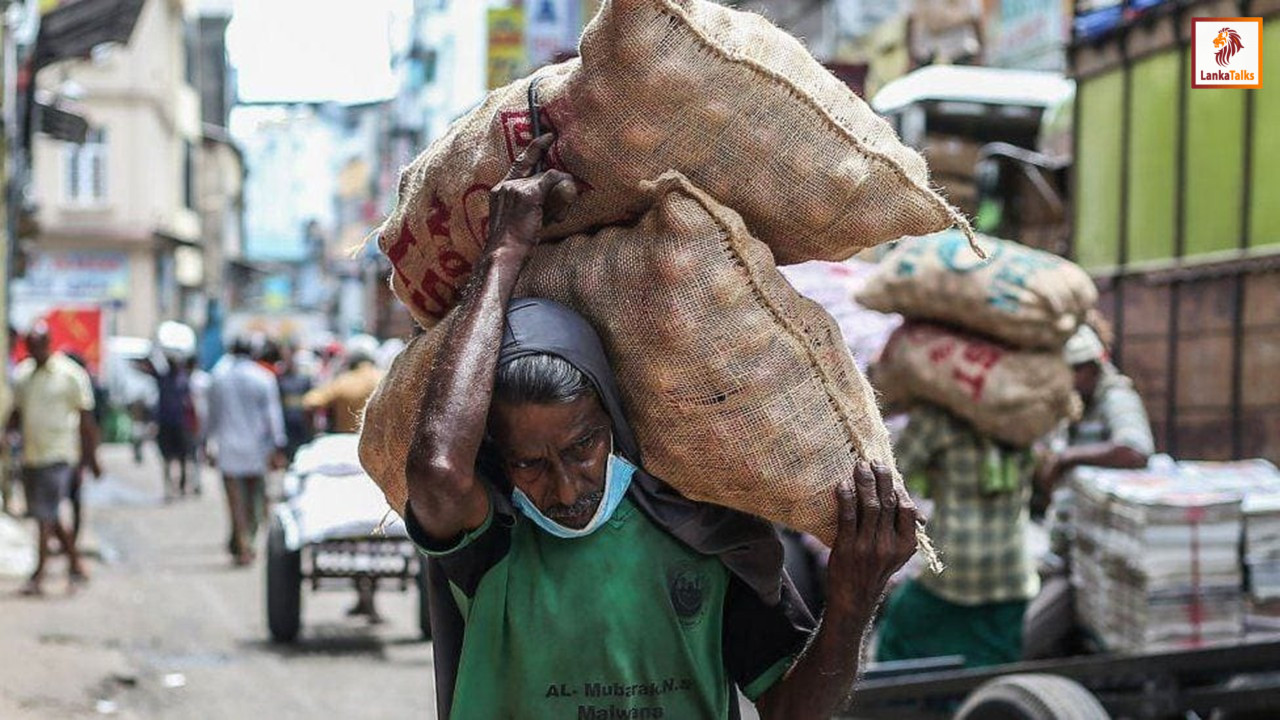
According to Prof. Hettige, this form of employment now defines the everyday reality of a majority of workers. He estimates that around 65% of Sri Lanka’s workforce is engaged in casual, informal, or irregular work – a figure that fundamentally shapes labour market behaviour, welfare dependence, and political vulnerability.
“Roughly 65% of workers are in irregular employment,” he said. “These are people who have no job security and nothing to fall back on.”
This structural vulnerability, he added, helped explain growing dependence on welfare and State support, particularly as households faced rising pressures related to education, healthcare, and transport costs.
Irregular employment spans multiple sectors. In agriculture, many labourers are hired seasonally or on a daily basis, often without written contracts. In construction, workers are increasingly hired as casual labour even when projects last for months, excluding them from formal employee status, provident fund contributions, or injury protection.
Sanitation workers, security guards, domestic helpers, and drivers frequently operate under similar arrangements, despite performing essential services.
Even long-term engagement does not guarantee security. Prof. Hettige noted that workers could spend decades in the same occupation or even with the same employer without ever becoming formal employees.
“Someone can work for 30 or 40 years and still have no pension, no EPF, and no retirement income,” he said.
The need for structural reform
Looking ahead, Prof. Hettige argued that addressing labour market challenges required a shift away from short-term relief towards structural reform, including the expansion of regular employment, contributory pension schemes, and broader social security coverage.
“If people know they have some protection when they are old, sick, or unemployed, they will feel secure,” he said.
He pointed to East Asian economies such as South Korea, where regular employment and mandatory social security contributions are widespread, as examples of what was achievable with sustained policy commitment.
“Regular employment is the key,” Prof. Hettige said. “Without it, precarious work will continue to define people’s lives.”
Informality complicates relief, identification, taxation
Speaking to The Sunday Morning Business, a senior official at the Ministry of Finance, Planning, and Economic Development, speaking on condition of anonymity, said that workers in informal and irregular employment had been among the most affected during recent relief efforts following Cyclone Ditwah, particularly when it came to accessing compensation.
“Irregular employment is a major issue in Sri Lanka,” the official said. “In some cases, people who were genuinely affected faced difficulties obtaining compensation because they could not provide documentary proof of employment or income.”
According to the official, the absence of formal employment records such as contracts, payslips, or employer certification made it difficult for authorities to verify eligibility, even when households were clearly vulnerable.
Identification-related issues further compound the problem, particularly among informal workers who move frequently or operate outside formal administrative systems.
The official added that the scale of informality also affected revenue collection, as many workers remained outside the tax net not necessarily out of avoidance, but due to fear and uncertainty. “People are afraid of paying taxes,” the source said.
This reluctance, the official noted, reinforced a cycle in which informal workers remained invisible to the State, limiting both their access to protection and the Government’s ability to design targeted policy responses.
Source - The Morning