


 Breaking News
 Tracy
Tracy Tracy
Tracy Aug 11 2026
 323
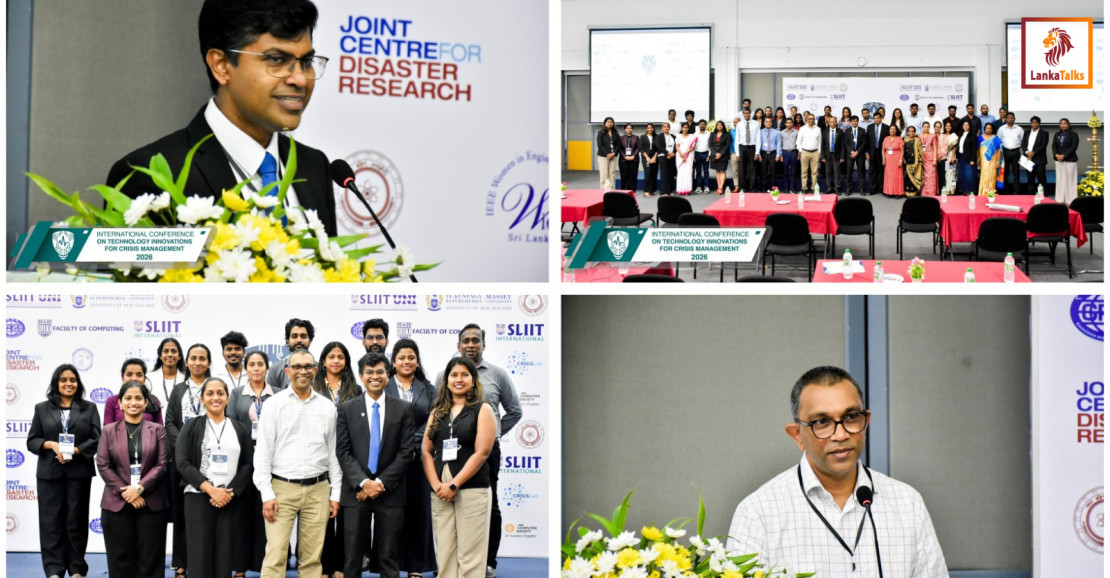
323SLIIT and Massey University (New Zealand) brought together global researchers, practitioners and policy experts at the International Conference on Technology Innovations for Crisis Management (ICTICM) 2026, spotlighting how emerging technologies can shift disaster management from reactive response to proactive preparedness.
The hybrid summit was jointly organised by the SLIIT Autonomous Intelligent Machines and systems (AIMS) Research Centre and Massey University's CRISISLab in New Zealand. It was co-chaired by Prof. Pradeep Abeygunawardhana, Dean of SLIIT's Faculty of Computing, and Prof. Raj Prasanna of Massey University, with Ms. Suranjini Silva serving as Conference Secretary.
Commenting on the summit, Prof. Pradeep Abeygunawardhana, Dean of SLIIT’s Faculty of Computing and Co-Chair of ICTICM 2026, said: “Technology can no longer be treated only as a tool for responding after disaster strikes. Through ICTICM 2026, we are bringing global expertise together to develop practical, locally relevant solutions that help communities anticipate risks, act earlier and recover more effectively.”
Discussions centred on the practical use of artificial intelligence, machine learning, the Internet of Things, digital twins, data analytics, GIS, remote sensing, robotics and decision-support systems. Researchers demonstrated applications including real-time disaster-zone mapping, predictive early-warning systems, infrastructure monitoring and crowdsourced tools to locate survivors and identify structural risks.
A keynote by Prof. Wensu Chen, Director of Curtin University's Centre for Infrastructural Monitoring and Protection, examined how AI and data-led decision systems can strengthen infrastructure resilience. He also presented research into "Advanced Metaconcrete," engineered to absorb severe impacts from explosions and seismic shocks.
ICTICM 2026 received 46 research submissions, with 28 papers accepted following international peer review. The programme also featured a panel on nature-based approaches, including mangrove restoration, watershed management and urban green infrastructure, and a cybersecurity workshop on incident response and disaster recovery led by Dr. Windhya Rankothge of the Canadian Institute for Cybersecurity.
The Sri Lanka Association for the Advancement of Science served as technical co-sponsor, organised a specialist panel and provided session chairs and co-chairs. Financial support came from SLIIT International, the IEEE GRSS Sri Lanka Chapter and SLIIT's Faculty of Computing.
For Sri Lanka, where floods, landslides, cyclones and coastal hazards remain persistent risks, the summit reinforced the value of translating global research into locally applicable, cost-effective resilience solutions. ICTICM 2026 also strengthened international collaboration and built capacity among students and early-career researchers working at the intersection of technology, sustainability and crisis management.