


 Breaking News
 Sheron
 Sheron
 Apr 16 2026
 719
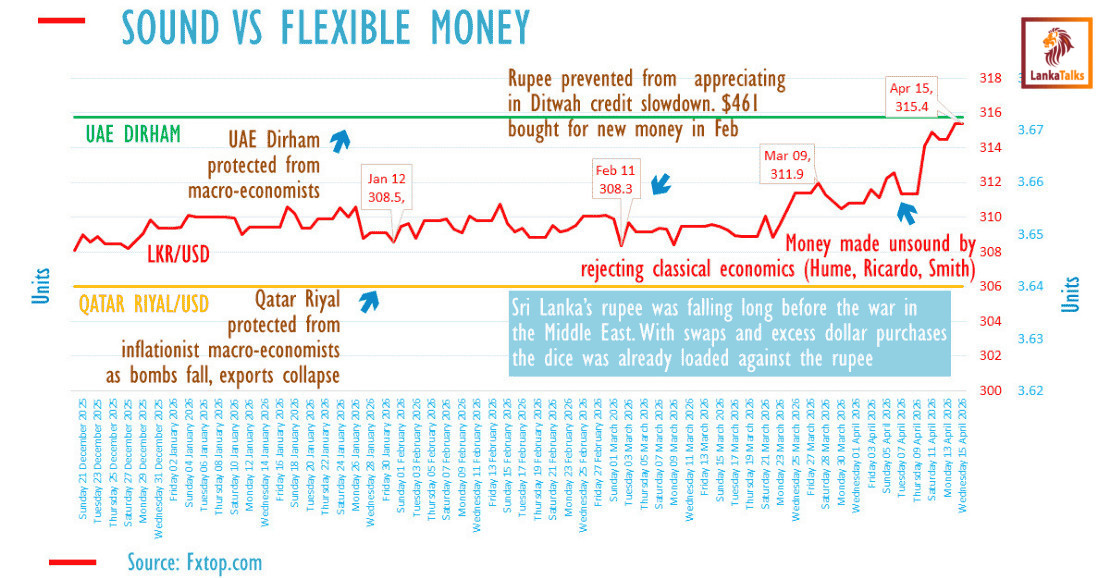
719Sri Lanka’s currency depreciation adds to the cost of imported oil and inflation, an economist warned as the rupee was depreciated from 300 to 315 to the US dollar by the central bank, amid massive excess liquidity generated from buy-sell swaps.
“Currency depreciation, as you know, amplifies the cost of oil imports, and that can also add to imported inflation pressures for the country,” Liliya Aleksanyan, Senior Country Economist, of the ADB Sri Lanka office told reporters after releasing an economic outlook report for 2026.
Currency depreciation not only pushes up imported food and energy commodities but also the rupee prices of exports, inflating the prices of commodities denominated by the notes of the central bank across the board including foods that are exported, hurting people in lower income brackets most.
Sri Lanka’s central bank started to escape accountability for exchange rate depreciation from around 1980 after the International Monetary Fund’s second amendment to its articles rejecting classical economics, creating inflation higher than ‘Great Inflation’ of the 1970s, analysts have pointed out.
The monetary depreciation undermined and discredited the most radical economic reforms ever carried out in the country and instead triggered widespread strikes and social unrest and pushed the country into back to back IMF programs until A S Jayewardene became central bank governor.
Concerns have been expressed throughout 2025 that the central bank generated around 400 billion rupees of excess liquidity (more than the excess money maintained to trigger an external default in 2022), in part by monetizing dollar assets of commercial banks with buy-sell swaps.
Sri Lanka’s rupee started to depreciate rapidly over 2025 as convertibility was denied by the central to money printed through swaps, and an auction system to purchase dollars from the market signaling exporters to sell and depreciated prices, critics have pointed out.
In April heavy moral suasion was deployed in a throwback to earlier episodes of printing money and denying convertibility.
In February the central bank bought 461 million dollars amid a Ditwah driven credit slowdown ruthlessly preventing the appreciation of the rupee validating a rise in cost of living (inflation target) by monetary depreciation critics have said.
A central bank that buys dollars in the market (a strong side convertibility) cannot simultaneously deny weak side convertibility (refuse to sell dollars to redeem its notes) unless the new notes are permanently extinguished with sales of its domestic assets, analysts have pointed out.
The currency of Dubai and Qatar which escaped the grip of mercantilists macro-economists in 1966 and is operated on classical economic principles (Hume, Ricardo, Torrence) has remained rock solid amid falling bombs.
RELATED : Sri Lanka rupee depreciation slams democracy amid sound money in Qatar, Dubai
The deprecation in 2025 and 2026 came as macro-economists ran out of usual excuses given in Sri Lanka (and other countries which have inflationist reserve collecting central banks with anchor conflicts) for creating external trouble such as ‘current account deficits’ and ‘budget deficits’.
Meanwhile the ADB said Sri Lanka’s inflation could rise to 5.2 percent in 2026 with higher energy prices and will remain around 4.6 percent the following year.
Before the IMF’s Second Amendment to its articles allowed the central bank to escape accountability for its flawed operating framework or deliberate inflationism, Sri Lanka’s inflation was the same as the US, analysts have pointed out.
source: Economy Next