


 Breaking News
 Tracy
Tracy Tracy
Tracy Jun 13 2026
 463
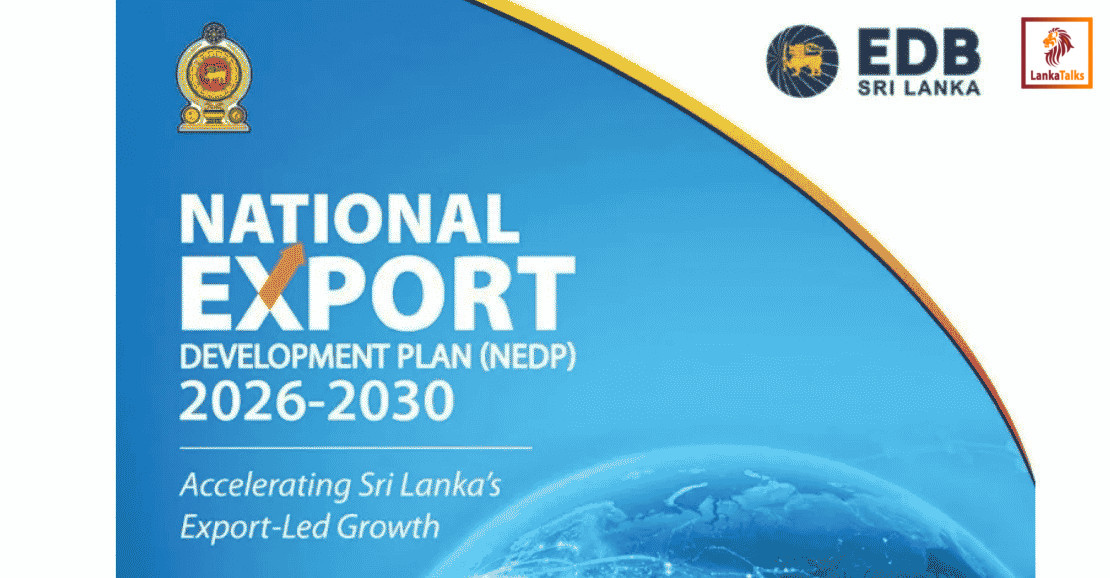
463Sri Lanka’s National Export Development Plan (NEDP) for 2026 to 2030, developed in collaboration between Sri Lankan state entity for export development, the Export Development Board (EDB) and Asian Pacific region multilateral Asian Development Bank (ADB), is to be launched next Tuesday (16), a statement made by the EDB said.
“Marking a new milestone in Sri Lanka’s economic journey, the official launch ceremony of the National Export Development Plan (NEDP) 2026-2030, the country’s strategic export roadmap for the next five years, is scheduled to be held in Colombo on 16 June 2026,” the statement said.
Based on previous statements made by EDB Chairperson Mangala Wijesinghe on the formulation process of the report, the five-year export strategy is a revamp of its predecessor: the National Export Strategy (NES) of 2018 to 2022.
Experts monitoring Sri Lanka’s trade policies have noted that this strategy had largely been abandoned during the 2019 Government transition. The 2018 NES had projected that Sri Lanka would reach $ 28 billion in annual exports earnings by 2022. Sri Lanka’s total export earnings for 2025 was $ 17.25 billion – the highest it has achieved in a year, to-date, though Sri Lanka also fell short of its $ 18.2 billion export earning target for 2025.
In a previous interview with The Daily Morning Business, Wijesinghe highlighted coordination issues as a major hurdle in executing the 2018-2022 NES.
“One significant challenge has been coordination among 40-50 institutions responsible for implementing the NES. Many agencies worked independently, focusing on their mandates rather than aligning with a unified national export agenda. This led to overlaps, inefficiencies, and diluted accountability, affecting the strategy’s effectiveness,” he said, emphasising that the NEDP aims to resolve the overlap in functions.
According to the EDB’s statement, the strategy’s primary objective is to enable Sri Lanka to achieve an export target of $ 36 billion by 2030. Further, it added that the formulation of this plan was proposed through the 2025 Budget, and was developed with the ADB under the Policy-Based Lending (PBL) Programme of the Ministry of Industry and Entrepreneurship Development.
“The national plan is structured around two main pillars, the first of which is the Horizontals, which provide the essential foundational support required to drive growth across all priority sectors.”
“These encompass trade facilitation, trade finance and investment ecosystem development, trade promotion and market access, supply chain management and consolidation centre operations, as well as quality infrastructure, standards, and Environmental, Social and Governance (ESG) compliance,” the statement said.
“Additionally, skills development, innovation, and entrepreneurship are also emphasised under this pillar. As the second pillar, eight priority sectors referred to as Verticals have been identified, targeting enhanced export diversification and value addition. These priority sectors are Auto Components, Minerals-Based Industries, Rubber-Based Industries, Marine-Based Industries (including boat and shipbuilding), Spices and Concentrates, Digital Products and Services, Electrical and Electronic Components, and Processed Food and Beverages.”
Source: The morning