


 Breaking News
 LankaTalks
 LankaTalks
 Apr 19 2026
 497
497Sri Lanka must unlock its public investment potential, as the nation’s capital spending has consistently fallen short of budgeted levels, an Asian Development Bank (ADB) official said last week.
Economics Analyst, Sri Lanka Resident Mission (SLRM) of the ADB, Nirukthi Kariyawasam was speaking at the Asian Development Outlook – April 2026 event on how the Middle East conflict challenges resilience in Asia and the Pacific, in Colombo.
The chronic trend of underutilisation of capital expenditure in the Budget is a major barrier to growth and may derail the nation’s hard-earned economic recovery.
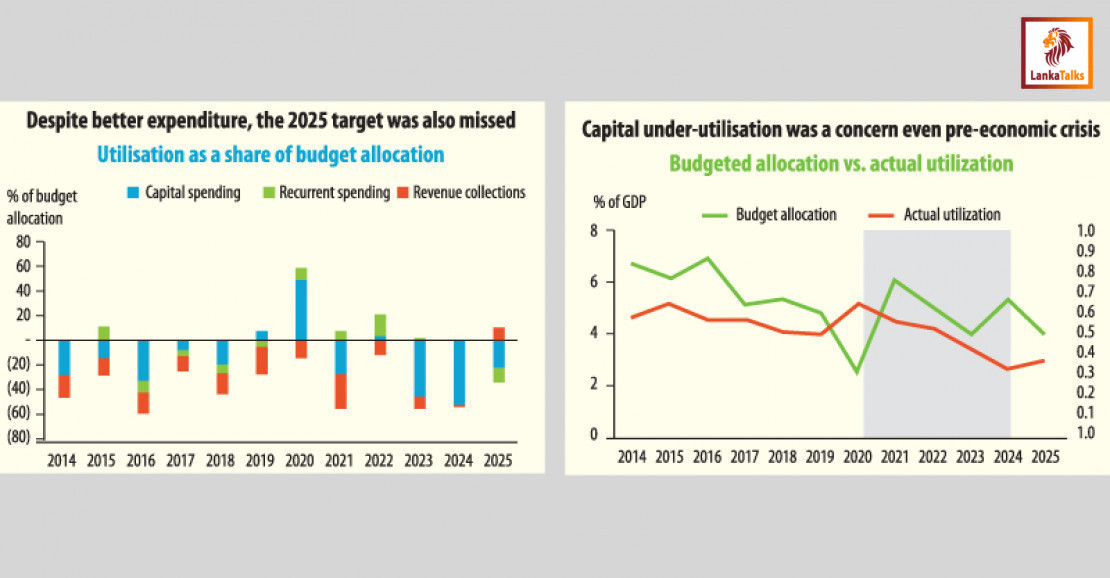
An ADB analyst said that although Sri Lanka has, in recent years, allocated around 5 to 6 percent of GDP for capital expenditure, actual utilisation has averaged only 2 to 3 percent. She said that capital underutilisation was a concern even prior to the economic crisis, and despite improved expenditure, the 2025 target was also missed.
Last year, Sri Lanka budgeted 5.4 percent of GDP for capital spending but utilised only 2.6 percent. However, the remaining amount was later redirected towards the Ditwah cyclone recovery. This year, Sri Lanka has allocated around 4 percent of GDP for capital expenditure, but the ADB projects that only about 3 percent will be used.
She said that pressures from recurrent spending have impacted effective public investment, with recurrent expenditure remaining rigid and weighing on fiscal performance. “Multi-year investment planning and fiscal planning remain challenges for the Government.”
“There is heavy crowding out of the development budget due to rising recurrent expenditure, such as interest payments and public sector salaries. Therefore, most allocations earmarked for capital expenditure are later diverted to cover recurrent spending,” the analyst said.
According to the ADB, rising interest payments — now accounting for a significantly larger share of Government expenditure than pre-crisis levels — have constrained fiscal space and crowded out public investment in infrastructure. Kariyawasam said that the long-standing gap between the allocation and execution of capital expenditure reflects deep-rooted structural and institutional weaknesses. She urged the Government to accelerate structural reforms in project execution, alongside greater fiscal discipline, supported by more realistic budgeting and stronger implementation capacity.
“Sri Lanka must strengthen its procurement processes, ensure effective project execution at the ministry level, and improve upfront project planning and inter-agency coordination,” she said.
She outlined the importance of improving monitoring, accountability and performance reviews, while stressing the need for wider private sector participation, mainly through public–private partnerships (PPPs).
The ADB analyst also pointed to inefficiencies in the timing of capital expenditure disbursement. According to the ADB, around 40 to 50% of annual capital spending is typically rushed in the last quarter of the year. “This pattern may undermine project quality and effectiveness,” she said. Delays in procurement, land acquisition, lack of feasibility studies, and weak inter-agency coordination were cited as key causes.
She also stated that although Sri Lanka expects over 37% growth in public expenditure this year, amounting to Rs. 1.4 trillion, reaching that target will be difficult without overcoming long-standing fiscal and administrative bottlenecks.
She cited the findings of the Public Investment Management Assessment-2019 (PIMA), saying that only about one-third of major projects had undergone proper feasibility studies, while over half had entered the budget without adequate preparation.
She said that recent adverse weather have heightened the urgency of reform, underscoring the need for faster and more resilient infrastructure development.
Source: Sunday Observer