


 Breaking News
 Sheron
 Sheron
 Mar 11 2026
 551
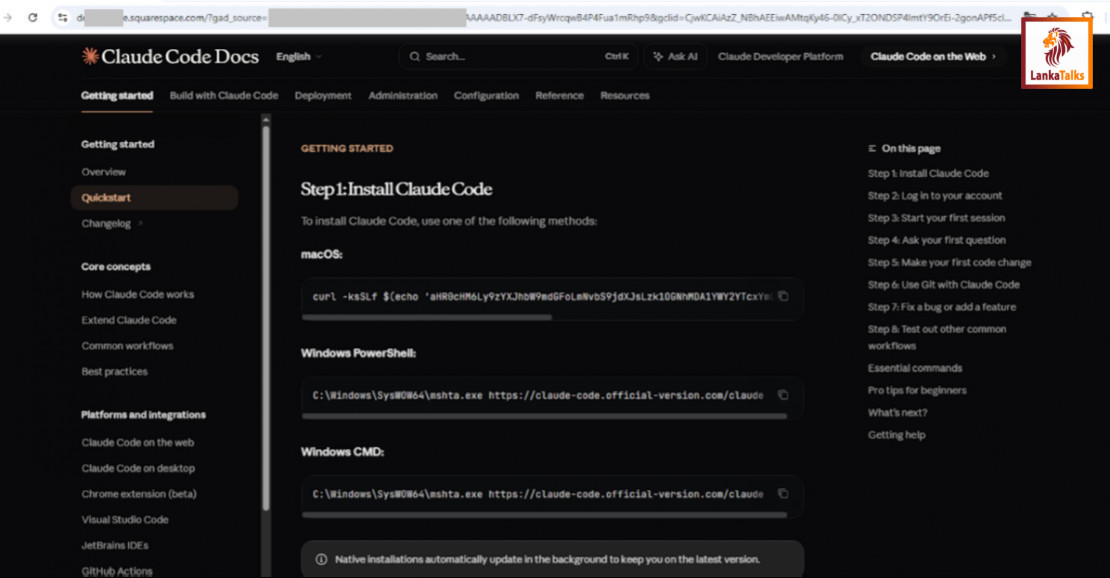
551In March 2026, Kaspersky Threat Research has identified a new malicious campaign targeted at developers looking for installation instructions for Claude Code, a development agent created by Anthropic. When searching for “Claude Code download”, sponsored advertisements appear at the top of the search results. One of these ads redirects users to a malicious webpage that closely imitates the official installation documentation for Claude Code. As a result, users are tricked into installing malware which harvests sensitive information including credentials, crypto wallet data, browser sessions, and other confidential files. Similar malicious campaigns mimic other popular AI tools, including OpenClaw.
The fake documentation page is visually identical to the legitimate one and is hosted on the website-building and hosting platform Squarespace. Because the page precisely copies the original instructions, users may not notice the difference when copying and executing installation commands.
However, instead of installing the developer tool, the commands deliver malware to the victim’s system. Depending on the operating system, the malicious commands deploy different infostealers: Windows systems receive Amatera, an information-stealing malware that collects data from user directories, web browsers, and cryptocurrency wallets before sending the stolen information to a remote server. Amatera has previously been observed in campaigns using the ClickFix distribution technique and is operated under a Malware-as-a-Service (MaaS) model. macOS systems receive AMOS, another infostealer previously documented in several malware campaigns targeting Apple devices. It has been described by Kaspersky before.
Kaspersky researchers also identified similar malicious campaigns targeting other popular AI tools, including OpenClaw and Doubao. Using the same approach, attackers registered multiple domains and distributed files containing the Amatera infostealer while disguising them as legitimate downloads for these tools.
“The campaign poses significant risks because AI development tools such as Claude Code and OpenClaw are widely used not only by hobbyists and automation enthusiasts but also by professional developers working in large organizations. If infected, victims may unknowingly expose source code from active projects, confidential corporate data, authentication credentials, and private accounts. This makes such campaigns particularly dangerous for businesses whose developers rely on AI-assisted coding tools,” comments Vladimir Gursky, cybersecurity expert at Kaspersky.
In December 2025 Kaspersky detected that attackers spread a macOS infostealer using Google Ads. A specially generated chat interface designed to resemble a ChatGPT tutorial pretended to guide users through installing the Atlas Browser. The malicious instructions appeared to be hosted on a legitimate site associated with OpenAI, helping attackers gain users’ trust.
To stay protected, Kaspersky recommends: Carefully verify download links and ensure they point to official project websites. Review any command-line instructions before executing them, especially if copied from external sources. Avoid following guides you did not specifically request or do not fully understand. Use reliable endpoint security solutions capable of detecting and blocking infostealers and malicious downloads.
Caption:
A fraudulent Claude page